Follow a San Saba Property From Pecan-Grove Parcel to Appraisal, Tax and Deed Record
San Saba Central Appraisal District is the starting point for owner searches, property IDs, geographic IDs, values, exemptions, agricultural appraisal, mineral accounts, business property, interactive maps and protests.
San Saba CAD is unusual because it also collects property taxes for several local taxing authorities. Recorded deeds, liens, releases and plats still belong with the San Saba County Clerk.
Property ID, geographic ID, owner ID or legal description.
601 W. Wallace Street, San Saba, Texas 76877.
8:00 AM-4:30 PM, closed noon-1:00 PM.
May 15 or 30 days after notice mailing, whichever is later.
Links and procedures reviewed July 2026.
What type of San Saba County property question are you solving?
Confirm the situs, legal description, improvements, homestead exemption and taxing units.
Follow the property-search stepsA normal street address may not identify a rural tract, pasture, orchard or divided ranch parcel.
Use the rural-land workflowReview qualifying use, acreage, application history and rollback exposure separately.
Prepare the land-use fileMineral interests can have a different owner, property ID and appraisal record from the surface estate.
Search mineral records correctlyFocus on value, unequal appraisal, acreage, property type, exemption, ownership or special appraisal.
Build the evidence packetUse CAD’s collection route for covered property taxes and the County Clerk for legal documents.
Choose the correct officeSelect a task and open the correct official resource
Use Basic Search, owner, property, criteria or advanced fields to find the official appraisal account.
Open official property searchUse the San Saba CAD search screen without entering too much information
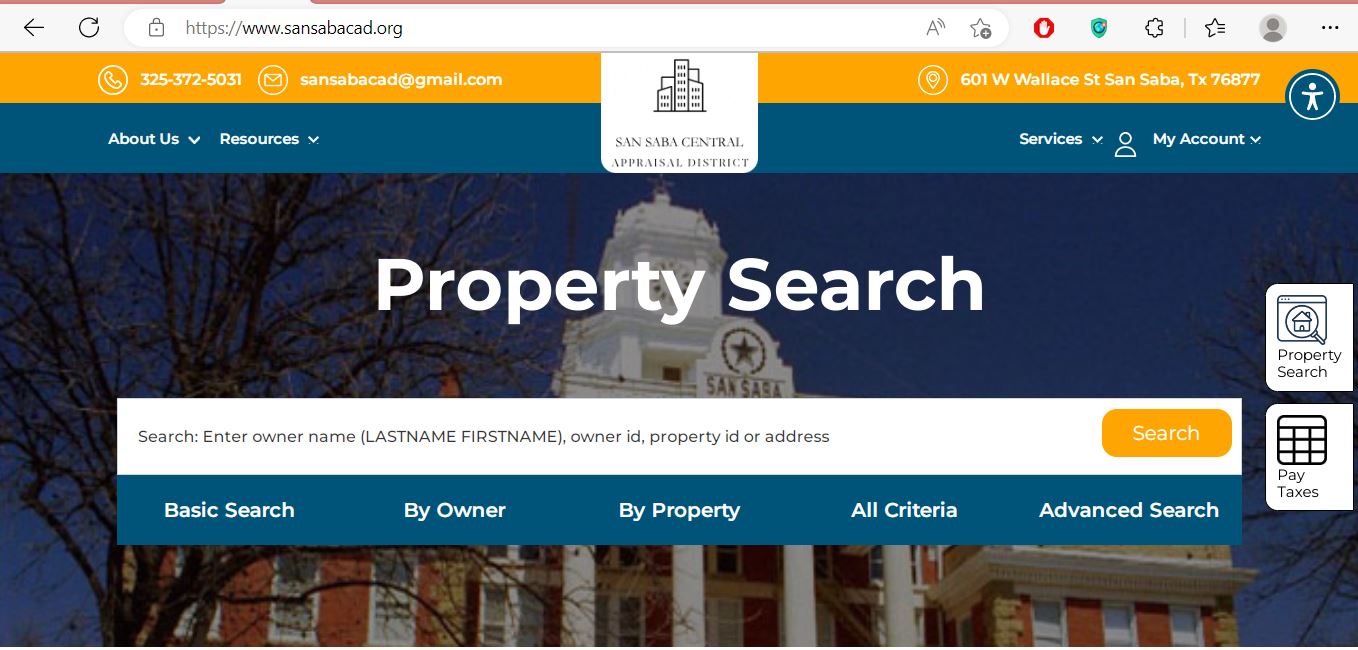
Search San Saba County property records step by step
Choose the strongest San Saba CAD search field for the property
| Search field | Best use | What to enter | What to check |
|---|---|---|---|
| Owner name | Home, ranch, business, estate, trust or mineral-owner lookup. | Last name first or one distinctive entity-name word. | Property type and property ID before opening the result. |
| Owner ID | Find accounts connected to one appraisal owner record. | The owner identifier shown by CAD. | Do not confuse it with property ID or geographic ID. |
| Property ID | Open a specific appraisal account. | The property number from a notice or prior CAD record. | Tax year and property type. |
| Geographic ID | Parcel, mapping, rural land and legal-description research. | The geographic identifier shown in the account. | Abstract, acreage and mapped parcel. |
| Legal description | Locate land with no reliable situs address. | A distinctive abstract, survey, lot, block or tract phrase. | Verify the complete description through the deed. |
| Abstract | Ranch, agricultural and older rural-property records. | Abstract name or number. | Survey, acreage and owner. |
| Subdivision | Platted lots, residential developments and grouped parcels. | The subdivision name from the legal description. | Lot, block, phase and property ID. |
| Lease name or number | Mineral, oil, gas, utility or industrial account research. | The official lease name or lease identifier. | Owner interest, property type and tax year. |
| Land acres | Narrow rural property by approximate acreage. | An acreage amount with an appropriate comparison operator. | Acreage in the deed or survey before legal use. |
| Value search | Find accounts within an appraisal-value range. | Minimum and maximum values. | Whether the result shows market, appraised or taxable value. |
Understand the San Saba CAD record before using it
| Account field | What it helps identify | What it does not prove | Next action |
|---|---|---|---|
| Parcel or property ID | The individual appraisal account. | That every county record uses the same number. | Use it when contacting CAD or matching payment records. |
| Geographic ID | A geographic or mapping reference for the property. | Surveyed boundaries or legal access. | Compare with the interactive map and recorded documents. |
| Owner shown | The owner carried for appraisal and tax administration. | Clear legal title or every mineral interest. | Use County Clerk records for legal ownership research. |
| Legal description | Abstract, survey, lot, block, tract, subdivision or acreage information. | That the abbreviated CAD description is sufficient for a deed. | Compare it with the recorded deed, plat and survey. |
| Property type | Real, personal, mineral, utility, industrial or another appraisal category. | That every related interest appears in the same account. | Search other property types under the same owner. |
| Market value | CAD’s opinion of market value as of January 1. | A guaranteed sale price or final tax bill. | Compare market and unequal-appraisal evidence. |
| Appraised value | Value after an applicable cap, circuit breaker or special appraisal. | The taxable value for every taxing unit. | Continue to exemptions and unit-specific taxable values. |
| Agricultural value | A special productivity-based appraisal for qualifying land. | Continued qualification after a use change. | Verify acreage, land-use history and current application status. |
| Tax due | An unpaid collection amount associated with the selected account and year. | That every taxing unit or year is included. | Open the full tax statement and payment details. |
Fix a missing, duplicated or confusing San Saba CAD result
| Problem | Likely reason | Practical fix |
|---|---|---|
| Owner name returns nothing | The record may use a trust, estate, spouse, business, operator or care-of name. | Search only the last name, one entity word or owner ID. |
| Too many accounts appear | The owner may have ranch, mineral, business and personal-property accounts. | Add property type, property ID, lease, abstract or tax year. |
| Rural address fails | The parcel may be indexed by county road, abstract, legal description or owner. | Search the road name only, then use abstract, geographic ID or map. |
| New owner is missing | The recorded deed may not yet have completed processing into the appraisal system. | Confirm recording with the County Clerk and save the instrument information. |
| Mineral account cannot be found | The account may use a lease name, operator, prior owner or separate mineral property type. | Use lease number, lease name, owner ID and the property-type filter. |
| Acreage appears incorrect | The account may reflect an older deed, appraisal mapping or an incomplete split or combination. | Compare the deed, plat and survey before requesting a CAD correction. |
| Tax due is unexpected | The search may show another tax year, unpaid unit, penalty, payment delay or separate account. | Open the complete tax statement and match every year and unit. |
| No online protest option appears | The account, notice or filing period may not be eligible for that online route. | Use the official Notice of Protest form or contact CAD before the deadline. |
Search San Saba County acreage when the postal address is not enough
Search specialised San Saba accounts separately from local real estate
Search owner, property type, lease name, lease number, property ID, geographic ID and tax year.
Confirm the owner, utility property type, location reference, account number and applicable taxing units.
Review the appraisal category, business owner, situs, values and specialist-appraisal information.
| Field | Why it matters | What it cannot establish |
|---|---|---|
| Property type | Separates mineral, utility or industrial records from real estate. | Complete legal ownership. |
| Lease name and number | Helps locate a producing-property or mineral account. | Every deed, reservation or royalty interest. |
| Owner and percentage | Shows the interest carried for appraisal and tax administration. | Clear mineral title. |
| Value and tax year | Mineral and industrial values can change from year to year. | Future production, revenue or final legal liability. |
| Legal or geographic information | Connects the account to the appraisal location or lease area. | Surveyed surface boundaries. |
Use the parcel map to confirm location—not a legal boundary
- Locate ranch and agricultural tracts
- Compare adjoining appraisal parcels
- Review roads and general location
- Confirm a likely search match
- Move from parcel view to property record
- Legal property lines
- Recorded easements
- Legal access
- Survey acreage
- Water or mineral rights
- Title or ownership disputes
Understand why San Saba values can change even without a sale
CAD’s opinion of what the property would sell for under normal market conditions as of January 1.
The value after an applicable residence-homestead cap, circuit breaker or special appraisal.
The value remaining after exemptions for a specific local taxing unit.
San Saba CAD’s 2025-2026 reappraisal plan identifies appraisal information such as property characteristics, maps, sales data, damage reports, permits, photographs, cost data and local market information.
Value may change after a field review, permit, addition, condition update or neighbourhood market analysis.
Review land class, access, acreage, market sales, special-use qualification and productivity value.
Specialist appraisal data, ownership, production, schedules or industry information can affect value.
Prepare the required documents before filing with San Saba CAD
Confirm ownership, principal-residence use, occupancy date and identification requirements.
Review the additional exemption, school-tax ceiling, instalment option and possible deferral.
Prepare qualifying disability documentation and verify ceiling or payment options.
Use the application matching the veteran’s rating, unemployability or surviving-spouse category.
Use the inherited-homes guidance and prepare deed, probate, heirship or occupancy evidence.
Official forms cover charitable, cemetery, disaster-damaged, vehicle, child-care and other qualifying property.
Homestead filing checklist
Document qualifying land use instead of relying on a rural address
Agricultural, open-space or wildlife appraisal is a special appraisal based on qualifying land use and productive capacity. It is not automatically granted because the property is rural, contains trees, has livestock occasionally or is described as a ranch.
Document grazing, livestock, crops, hay, orchard activity, beekeeping or another qualifying local use.
Prepare the management plan, prior qualifying use and evidence of the required wildlife activities.
Use the land-lease affidavit and retain agreements, payment records and evidence of actual use.
Evidence to organise before filing
File the rendition with a complete asset and location record
A business rendition reports taxable inventory, furniture, fixtures, machinery, equipment and other income-producing personal property owned or managed on January 1.
| Rendition item | What to organise | Why it matters |
|---|---|---|
| Business identity | Legal name, DBA, owner, mailing address and physical situs. | Connects the filing to the correct account. |
| Asset inventory | Equipment, machinery, furniture, fixtures, tools and taxable vehicles. | Supports classification and valuation. |
| Acquisition history | Original cost, purchase year and disposal date. | Supports depreciation and current ownership. |
| Leased assets | Owner, lessee, agreement and property location. | Prevents duplicate or omitted reporting. |
| Inventory value | Applicable inventory records and good-faith value information. | Inventory can materially affect taxable value. |
| Supporting evidence | Fixed-asset schedule, invoices, photographs and prior renditions. | Helps answer CAD questions or support a protest. |
File first, preserve proof and then build the San Saba evidence packet
Evidence ideas by San Saba property type
Comparable sales, dated photographs, repair estimates, measurements and incorrect building details.
Land sales, access, terrain, water, fencing, land class, deed acreage and survey information.
Ownership interest, lease information, production, reserves, pricing and specialist appraisal data.
Tree condition, irrigation, production, access, land use and comparable specialised property.
Asset cost, age, condition, disposal records, functional obsolescence and depreciation.
Similarly situated accounts with important differences identified and adjusted.
Prepare for the formal hearing before the appointment date
The ARB hears unresolved appraisal protests and issues a written order for the property and tax year.
Organise the strongest property-specific evidence before background documents or general market opinions.
Preserve the order immediately because later arbitration, court or SOAH deadlines can be short.
ARB hearing checklist
Use San Saba CAD, the county tax office or County Clerk correctly
| Your question | Best official route | What to prepare |
|---|---|---|
| Why did the appraised value change? | San Saba CAD | Property ID, tax year, notice and disputed property details. |
| Is the homestead exemption active? | San Saba CAD | Application confirmation, identification and qualification date. |
| Does the land have agricultural appraisal? | San Saba CAD | Acreage, use history, application and production evidence. |
| How much collected property tax is due? | San Saba CAD tax collection and payment portal | Property ID, tax year, owner and tax statement. |
| Did the property-tax payment post? | San Saba CAD collection office | Receipt, confirmation number, date, amount and account. |
| Vehicle title or county assessor service | San Saba County Tax Assessor-Collector | Identification and service-specific documents. |
| Who legally owns the property? | San Saba County Clerk or title professional | Grantor, grantee, legal description and recording period. |
| Where is the legal boundary? | Recorded deed, plat and licensed surveyor | Current deed, prior survey, title documents and map reference. |
| Who owns the minerals? | County Clerk, attorney or mineral-title professional | Mineral deeds, reservations, assignments, probate and leases. |
Pay San Saba County property taxes through the CAD collection route
| Payment issue | General rule | Practical action |
|---|---|---|
| Tax statement | Statements are generally mailed in October and are due on receipt. | Search the account if no bill arrives rather than waiting until January. |
| 2026 tax payment | January 31, 2027 falls on Sunday. The next-business-day rule generally permits timely payment on Monday, February 1. | Use the date printed on the official statement and retain proof of payment. |
| Delinquency | For a normal 2026 bill, delinquency would generally begin Tuesday, February 2, 2027 after the weekend adjustment. | Request the live payoff if the account is delinquent. |
| Late original bill | A bill mailed after January 10 can have a postponed delinquency date that provides at least 21 days to pay. | Follow the delinquency date printed on that bill. |
| Missing statement | Failure to receive a statement does not normally cancel the tax, lien, deadline, penalty or interest. | Keep the appraisal mailing address current and check the account independently. |
| Quarterly payments | Qualifying age-65 or disabled homestead owners may elect four instalments under Texas law. | Contact CAD before the first deadline and follow the statutory payment schedule. |
Use the San Saba County Clerk for deeds, liens, releases and plats
| Requirement or fee | Published information | Practical note |
|---|---|---|
| First recording page | $25 | Confirm the complete fee before mailing or filing. |
| Additional pages | $4 per additional page | Count every page in the document. |
| Original document | Original documents with original signatures are required for recording. | The office states that a normal copy is not accepted for recording. |
| Return envelope | Provide a self-addressed stamped envelope for mailed filings. | Confirm the correct return address. |
| In-person filing ID | Valid photo identification is required for a person presenting a real-property document in person. | Bring current government-issued photo ID. |
| Late-day processing | Documents received after 4:30 PM Monday-Thursday or 3:30 PM Friday are processed the next working day. | Arrive earlier for deadline-sensitive recording. |
Use the Data and Records page for reports, rolls, tax rates and tax-sale notices
Available resources include real and personal rolls arranged geographically, alphabetically and in spreadsheet format.
Use the published mineral appraisal-roll download for bulk mineral-account research.
Review field work, data collection, valuation procedures and appraisal responsibilities.
Use these reports to understand models, sales analysis, schedules and valuation methods.
Business owners can review the current BPP schedule when preparing rendition or protest evidence.
The page publishes current and historical tax-sale notices, including notices scheduled during 2026.
Review adopted rates and five-year tax worksheets for local taxing jurisdictions.
Use partial-exemption compilations for district-level transparency and historical research.
Use the official request form for identifiable existing records not already published online.
Important San Saba County appraisal and tax dates
San Saba CAD, county tax office and County Clerk details
San Saba, Texas 76877
Phone: (325) 372-5031
Fax: (325) 372-3325
Email: sansabacad@gmail.com
Hours: Monday-Friday, 8:00 AM-4:30 PM.
Closed daily from noon to 1:00 PM.
Chief Appraiser: Trish Turner
David Jenkins
500 E. Wallace Street, Suite 115San Saba, Texas 76877
Phone: (325) 372-5325
Fax: (325) 372-5425
Chief Deputy: Lois Lebow
This county office is separate from San Saba CAD’s property-tax collection operation.
Christi Whitley
500 E. Wallace Street, Suite 202San Saba, Texas 76877
Phone: (325) 372-3614
Hours:
Monday-Thursday: 8:00 AM-noon and 1:00-5:00 PM.
Friday: 8:00 AM-noon and 1:00-4:00 PM.
San Saba CAD assigns a unique online-account PIN to a property.
Create or sign in to an online account, then complete the official request process.
Request an online account PINSan Saba County property resources
Search owner, address, IDs, abstract, subdivision, lease, acreage, value and tax-due information.
Open property searchReview general parcel location and nearby appraisal-property context.
Open interactive mapDownload exemptions, agricultural, wildlife, rendition, protest and miscellaneous forms.
Open forms libraryPay an eligible San Saba CAD-collected property-tax account online.
Open online paymentReview appraisal rolls, tax rates, reports, depreciation schedules and tax-sale notices.
Open Data and RecordsRequest the PIN needed for supported account and online functions.
Request property PINCheck current staff, address, phone, fax, email and map information.
Open CAD contact pageUse for county assessor-collector and motor-vehicle services separate from CAD collections.
Open county tax officeUse for recorded deeds, liens, releases, plats and filing requirements.
Open County ClerkHow this San Saba County guide was rebuilt

Existing images preserved with deeper local workflows
This regenerated version preserves the existing San Saba CAD property-search and editor images while replacing the former short guide with detailed search fields, ranch and mineral workflows, appraisal explanations, agricultural preparation, business rendition, protest evidence, tax-payment verification and deed-record guidance.
Official resources reviewed include San Saba Central Appraisal District, its property search, map, forms, data and records, contact pages, payment route, San Saba County Tax Assessor-Collector, County Clerk and Texas Comptroller property-tax guidance.
AppraisalDistrict.org is an independent informational website and is not operated by San Saba Central Appraisal District or San Saba County.
10 common San Saba CAD questions
1. What is the official San Saba CAD website?
The official website is sansabacad.org. Its homepage includes property search and official links for maps, forms, records, protests and tax payment.
2. How do I search San Saba County property records?
Use Basic Search, By Owner, By Property, All Criteria or Advanced Search. Available fields include owner ID, owner name, property ID, geographic ID, address, legal description, abstract, subdivision, lease, acreage and value.
3. Why does an owner or address search return no result?
The account may use a trust, estate, business, care-of name, rural legal description or lease. Try the owner’s last name or street name alone, then use property ID, geographic ID, abstract, subdivision or map search.
4. Can I search San Saba County mineral property?
Yes. Use the property-type filter, lease name, lease number, owner, property ID and geographic ID. Confirm that the result is a mineral account rather than the surface property.
5. Can I file a property-tax protest online?
Open the correct property record and use File a Protest when the option is available. Otherwise, download the Notice of Protest form from the official forms page and file it by an accepted method.
6. What is the San Saba County protest deadline for 2026?
Most protests are due by May 15 or 30 days after San Saba CAD mails the Notice of Appraised Value, whichever is later. Follow the deadline printed on the notice.
7. What is the 2026 Texas school homestead exemption?
A qualifying residence homestead receives a $140,000 school-district exemption. A qualifying age-65 or disabled homeowner receives an additional $60,000 school exemption.
8. Where do I pay San Saba County property taxes?
San Saba CAD collects property taxes for several local authorities. Payments may be mailed, placed in the CAD drop box or made through the official online payment portal.
9. Does the CAD owner name prove legal ownership?
No. Use the San Saba County Clerk’s real-property records for recorded deeds, liens, releases, plats and legal document history.
10. Where is San Saba Central Appraisal District located?
The office is at 601 W. Wallace Street, San Saba, Texas 76877. The phone number is (325) 372-5031. Published hours are 8:00 AM-4:30 PM, Monday-Friday, with a noon-to-1:00 PM closure.